¶ League Military Uniforms
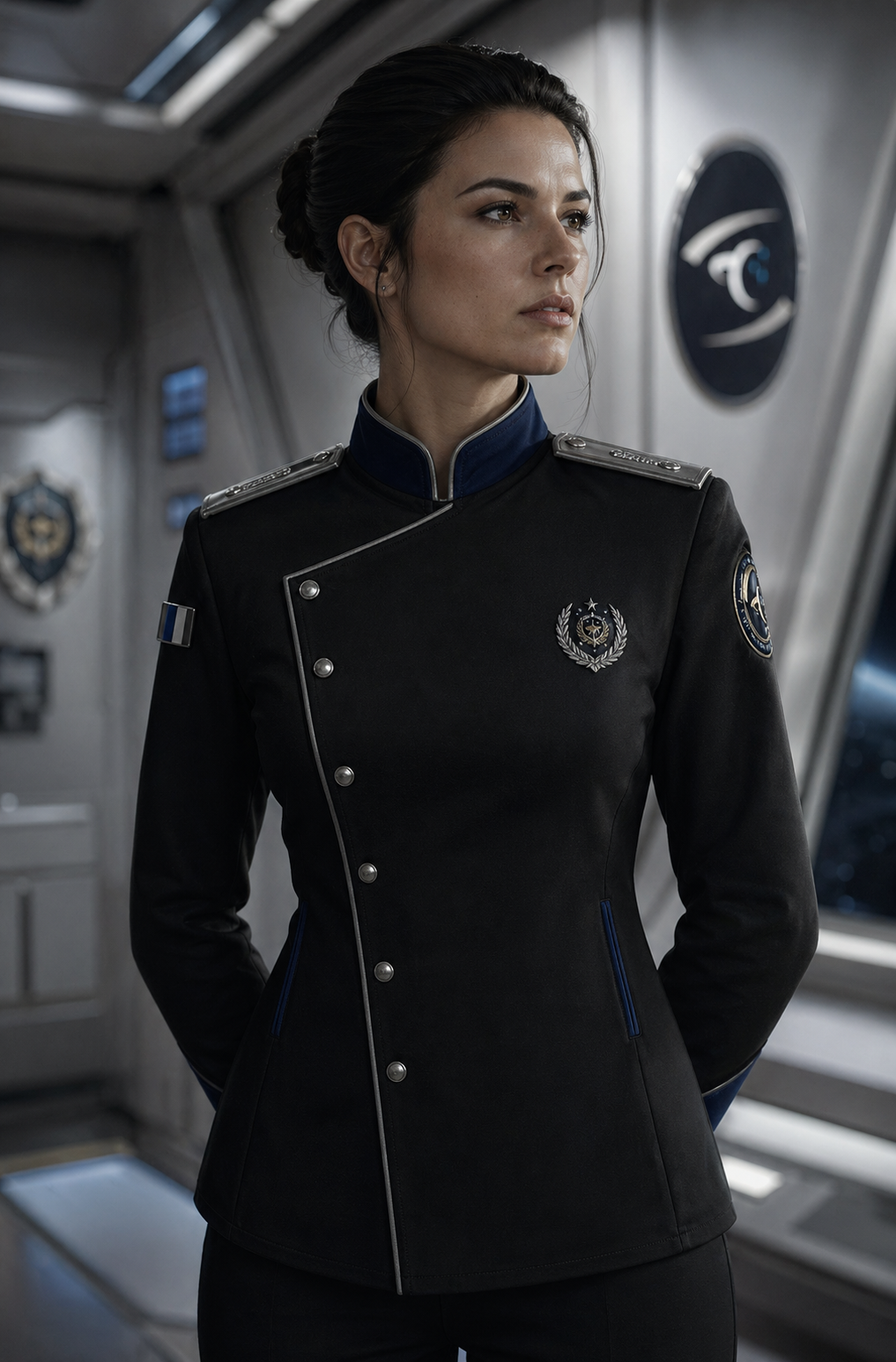
Full Dress Skirt Example

Full Dress Skirt Example
Military uniforms serve multiple purposes beyond simple identification. They establish hierarchy, foster unit cohesion, and provide appropriate attire for diverse operational requirements. The League Navy maintains four primary uniform categories, each designed for specific duty requirements while maintaining the professional bearing expected of naval personnel. This system, evolved from Earth's maritime traditions and adapted for the realities of space warfare, ensures personnel have appropriate attire whether attending diplomatic functions, conducting routine maintenance, or engaging in combat operations.
The standardization of uniforms across the League Navy promotes unity among diverse human colonies while allowing limited customization for unit pride and individual achievement. Each uniform category represents a balance between tradition and practicality, acknowledging that modern naval service encompasses everything from ceremonial duties to extended deployments in hostile environments.
¶ Uniform Insignia Standards
Across all duty uniforms (Service Dress, Daily Work, and Flight Suit), the League maintains consistent insignia placement: name patches are positioned over the left breast while rank insignia occupies the right breast position. The League flag adorns the right arm of all duty uniforms, symbolizing service to the greater collective, while unit or ship patches on the left arm represent immediate loyalty to one's crew and vessel. This standardization ensures immediate recognition regardless of uniform type, though the Full Dress Uniform follows different conventions befitting its ceremonial nature.
¶ Full Dress Uniform
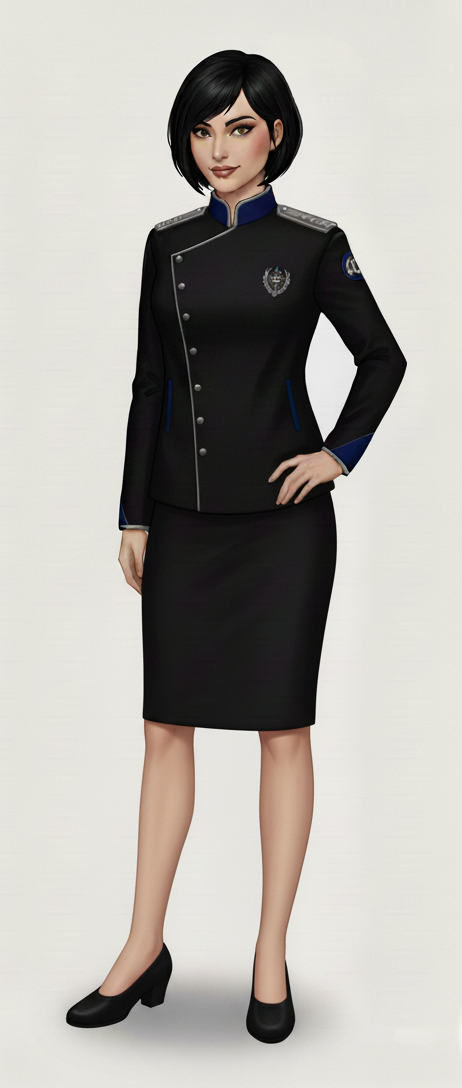
Full Dress Skirt Option
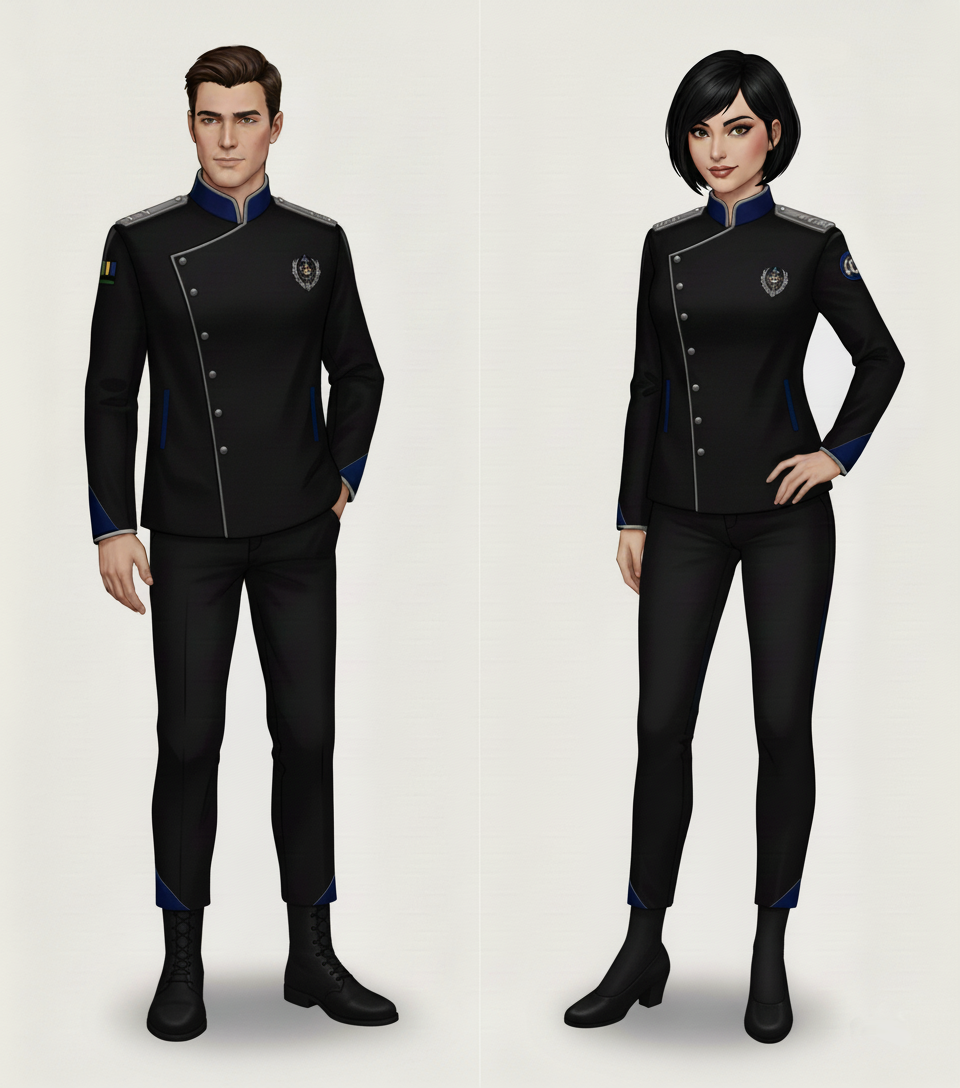
League Full Dress
- Role: Ceremonial, parades, high-level diplomacy, funerals, weddings.
- Style: Highly ornate, medals/ribbons, polished boots, decorative elements unique to your faction.
- Frequency: Rare, pulled out when maximum formality is needed.
Reserved for occasions demanding maximum formality, the Full Dress serves as the public face of League naval tradition. Unlike duty uniforms, Full Dress incorporates rank and identification into its formal design elements rather than utilizing patches. Officers typically maintain one immaculate set, often at personal expense beyond the standard issue. The uniform includes both trouser and skirt variants, with reasonable heels permitted regardless of the wearer's gender - a reflection of the League's commitment to personal choice within professional standards.
Full Dress is mandatory for courts-martial, changes of command, state funerals, and diplomatic receptions. Junior officers may go years without wearing it, while flag officers find themselves in Full Dress monthly. The uniform deliberately sacrifices practicality for presence - it cannot be worn while performing actual shipboard duties and requires significant preparation time to don properly. Many officers keep their Full Dress in specialized storage to maintain its condition between rare uses.
¶ Service Dress Uniform
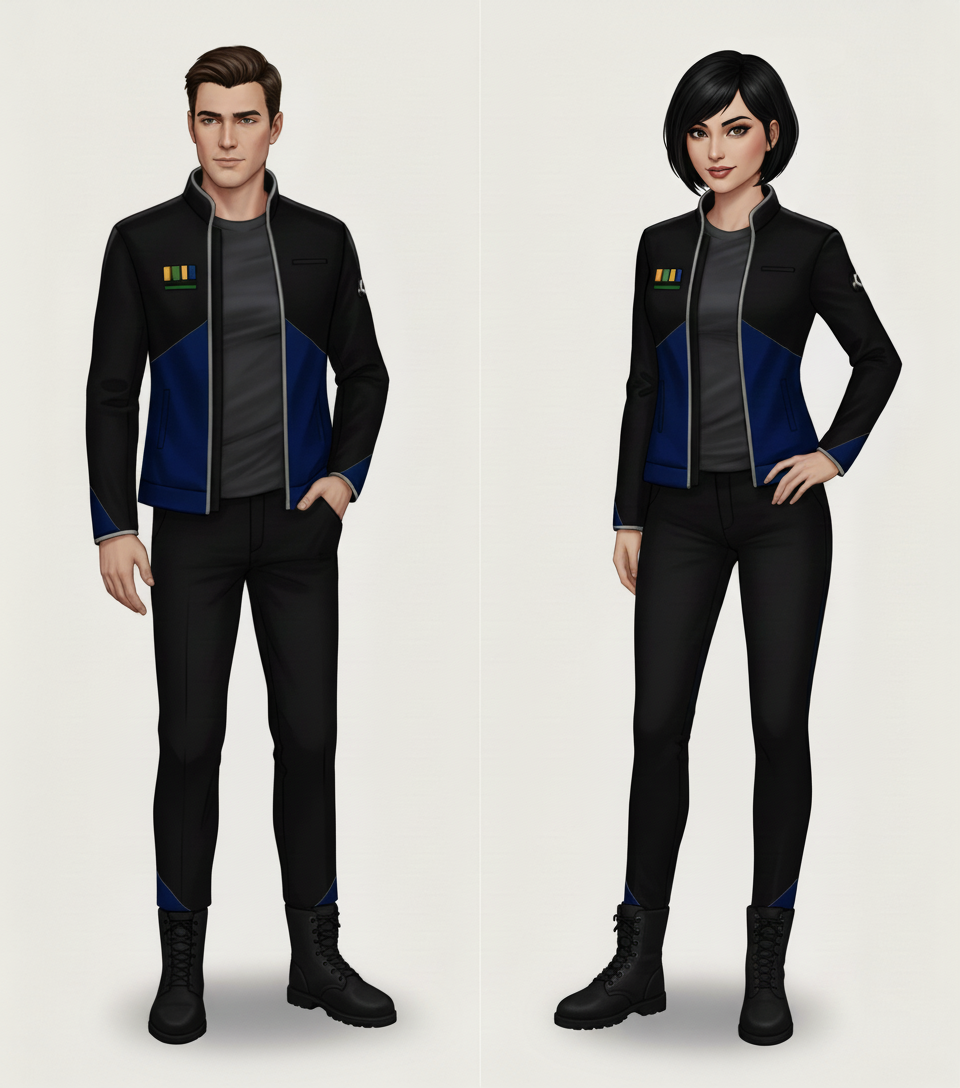
League Service Dress
- Role: Office wear, staff meetings, inspections, formal but not ceremonial.
- Style: Jacket/blazer, insignia but minimal pomp.
- Frequency: Common for officers, staff, and anyone expected to "look sharp" without being on parade. Common for Bridge Officers.
The Service Dress bridges the gap between ceremonial and practical requirements. Standard insignia placement applies - name left, rank right, League flag on the right arm, ship patch on the left arm. The removable jacket can be quickly doffed when transitioning from administrative to operational duties, leaving the wearer in an acceptable undershirt for immediate action. This flexibility makes it the preferred choice for bridge officers who may need to shift from hosting dignitaries to managing combat operations within minutes.
Regulations require Service Dress for official briefings, boards of inquiry, and when reporting to new commands. The uniform sees heaviest use in fleet headquarters and diplomatic stations where professional appearance matters but Full Dress would be excessive. Many senior enlisted and officers wear Service Dress daily when not expecting operational duties, appreciating its professional appearance without the maintenance requirements of Full Dress.
¶ Daily Work / Field Dress Uniform
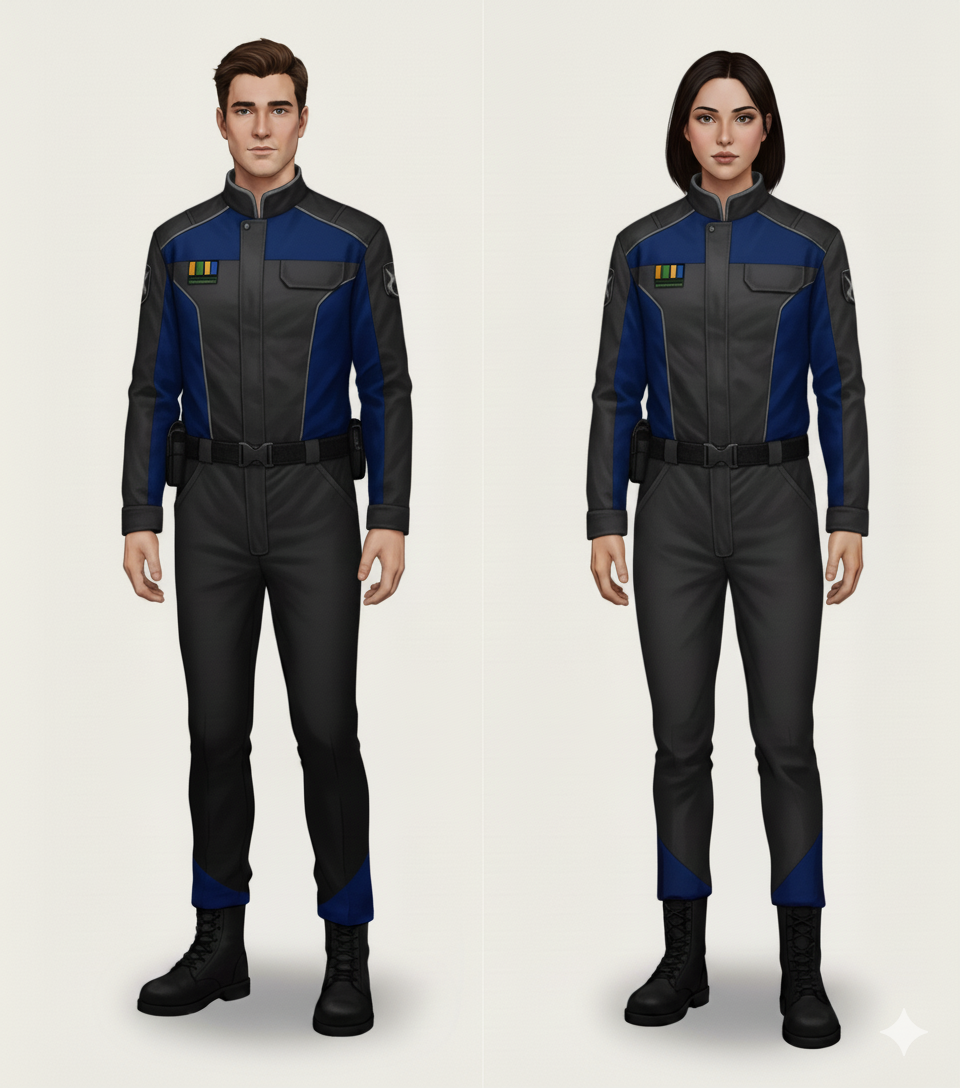
League Daily Work
- Role: Shipboard duty, general day-to-day tasks, and non-ceremonial active duty.
- Style: Practical, comfortable, designed for long wear inside ships and stations. Still tailored and identifiable, not "camo" or fatigues.
- Frequency: Default for enlisted, bridge crew, engineers, etc.
The backbone of fleet operations, the Daily Work uniform is engineered for the realities of shipboard life. Standard patch configuration identifies personnel at a glance - name on left breast, rank on right, League flag on right arm, and ship assignment on the left arm. Integrated wrist and ankle cuffs can form airtight seals when properly activated, while the reinforced collar accepts the standard Emergency Deployable Helmet (EDH) - a compact device worn around the neck that can instantly deploy a single-use pressure helmet. Together, these features transform the uniform into a temporary pressure suit capable of sustaining life for 10-15 minutes in vacuum - enough time to reach proper emergency equipment or safe compartments.
This is what most League personnel wear for 90% of their service. Designed for 18-hour shifts, the uniform's materials resist staining, self-clean through molecular action, and maintain temperature regulation across the varied environments found aboard warships. Regulations permit minor modifications for specialized ratings - engineers often add additional tool loops, while medical personnel incorporate antimicrobial linings. The uniform must withstand everything from reactor maintenance to combat stations, making durability paramount.
¶ Flight Suit
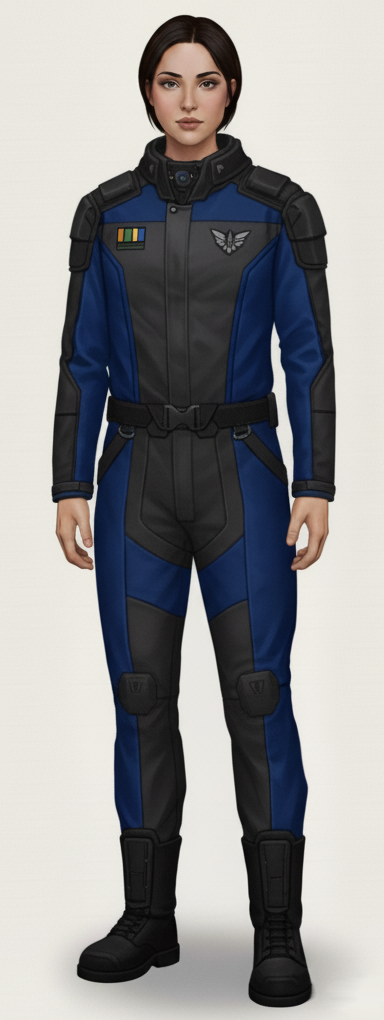
League Flight Suit
- Role: Pilots, EVA, aerospace/spacecraft crew in specialized roles.
- Style: One-piece suit with survival features, seals, modular add-ons (helmets, harnesses).
- Frequency: Worn whenever flying or working in zero-G environments.
More than a uniform, the flight suit is survival equipment. Flight crews display a unique patch configuration reflecting their dual identity as both naval personnel and aviators: the name patch sits on the left breast with the Spaceforces insignia directly below it, while abbreviated rank insignia occupies the right breast position with squadron patch beneath. The ship patch remains on the left arm per standard convention, maintaining the connection to their assigned vessel. The abbreviated rank insignia uses simplified symbols rather than full naval rank boards, allowing quick identification in cramped cockpits while conserving space for the squadron identifier that pilots consider equally vital.
The suit incorporates a removable rigid neck collar that creates an airtight seal between suit and helmet. This critical component must be removed before the suit can be unzipped, forcing pilots to follow proper decompression protocols and preventing accidental suit breaches during operations. The collar's rigid structure also provides protection against acceleration forces, supporting the neck during high-G maneuvers. When paired with standard flight gloves and helmet, the complete ensemble functions as a legitimate EVA suit rated for 20-30 minutes of vacuum exposure, though exceptional cases have recorded survival times exceeding three hours. This capability has saved countless pilots following cockpit breaches or emergency ejections in deep space.
Flight crews wear these exclusively while on flight status, with regulations forbidding their use as general duty uniforms despite their superior protection. The suits require specialized maintenance and regular recertification to ensure pressure integrity. Each pilot typically maintains two suits - one for regular operations and a backup undergoing inspection or repair. Squadron commanders have authority to authorize personalized markings within strict guidelines, acknowledging the unique esprit de corps of aviation units while maintaining operational standards.
The suit's integrated systems interface directly with spacecraft controls, monitoring pilot vitals and automatically adjusting compression zones during high-G maneuvers. This symbiosis between pilot and machine represents the pinnacle of League military technology, making the flight suit as much a piece of spacecraft equipment as personal uniform.